
 When you’re starting to drown between employee concerns, payroll duties and helping your CEO -- HR Insider is there to help get the logistical work out of the way.

As many as 20% to 30% of all Canadian workers engage in some form of “gig work,” like driving, freelance writing, developing websites, and even pet-sitting. So, it’s only a matter of time before your company partakes in the new gig economy, if it doesn’t already. As an HR director, it’s incumbent on you to ensure that your employment relationships with gig workers comply with legal requirements. The stakes are high. Exhibit A: The massive class action lawsuits filed by Uber driver and Foodora couriers. The compliance conundrum is that there really aren’t any gig worker employment laws—at least in most of the country. But that’s starting to change. Here’s a briefing on what laws there are that do apply to gig employment in Canada.
Current Legal Protections for Gig Workers in Canada
The current laws that regulate employment were first enacted decades before gig employment was a thing. Back in those days, there were 2 basic kinds of work arrangements: employment and independent contracting. Gig work falls somewhere in the middle of these classifications. Like independent contractors, gig workers have the freedom to make their own schedules or even decide not to work at all; but they’re also financially dependent on their employers the way employees are.
The unfortunate consequence of relying on 20th century laws to regulate 21st century employment is that gig workers fall through the cracks. Luckily, the laws are slowly starting to catch up. But it’s been a long process that’s still in its infancy stage. Progress varies by both jurisdiction and type of law involved. Let’s take a quick tour of the old employment laws and how they apply to gig workers.
-
Labour Relations Laws
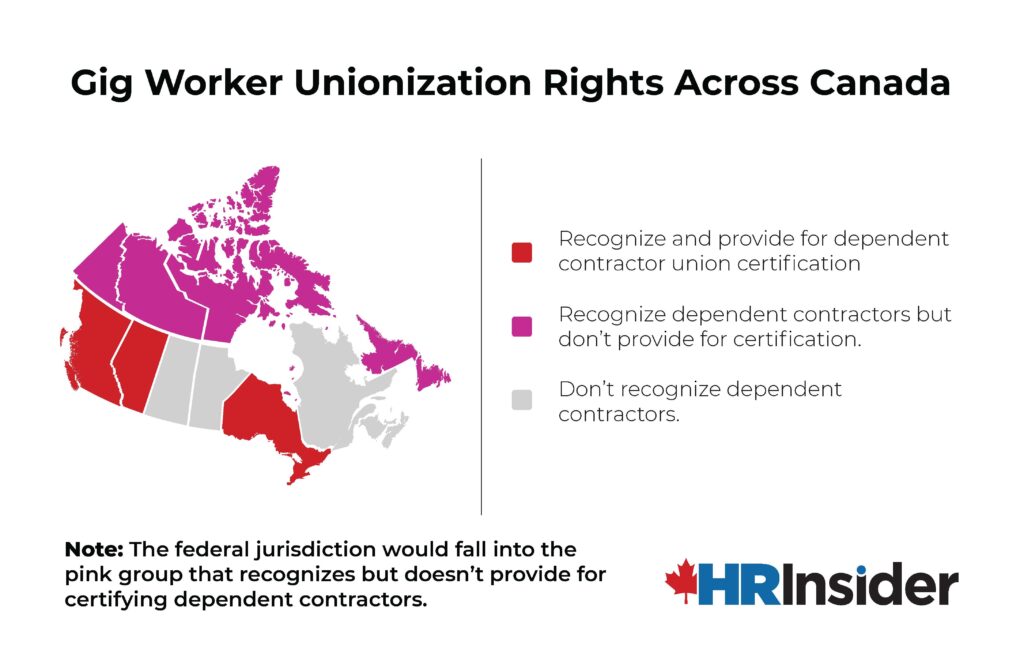
Provincial labour relations laws regulate trade unions and collective bargaining. While these laws don’t specifically address gig workers, 8 jurisdictions (all but MB, NB, NS, PEI, QC, and SK) now recognize a new class of worker with unionization rights called a “dependent contractor” generally defined as a person who:
- May or may not have an employment contract.
- May or may not furnish their own tools, equipment, machinery, or material.
- Work for an employer under terms and conditions that make them economically dependent on the employer under a relationship that’s more like an employment than an independent contractor relationship.
Alberta, BC, and Ontario also provide a special union certification process for dependent contractors.
Note
*The federal jurisdiction would fall into the pink group that recognizes but doesn’t provide for certifying dependent contractors.
2. Employment Standards Laws
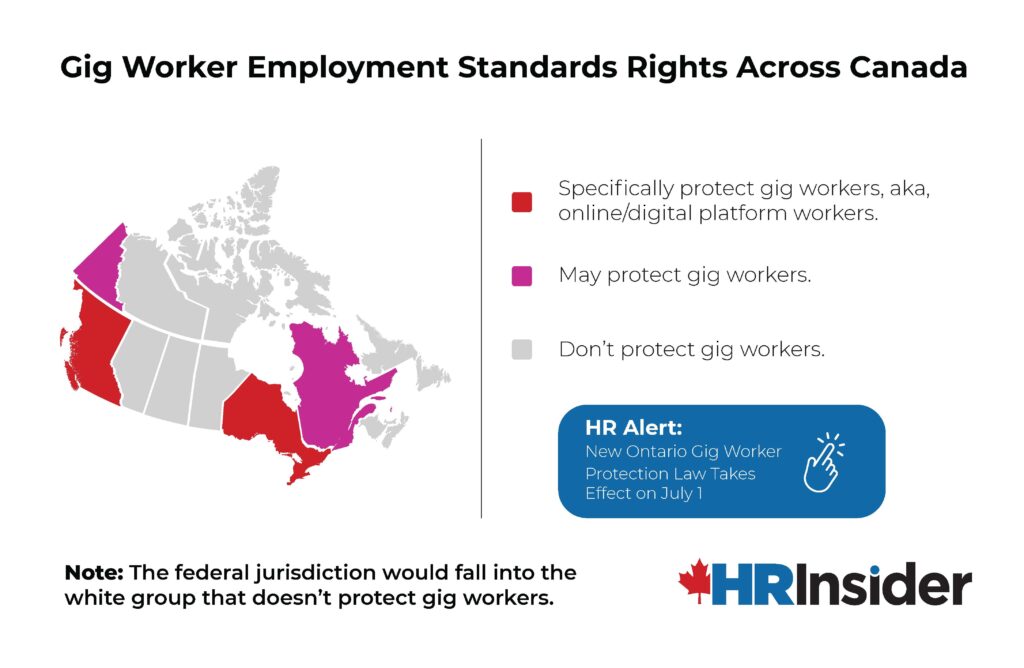
Employment standards laws regulate the wage, work hours, and other employment terms of non-union workers. Of course, these laws are critical because most gig workers aren’t in a union. BC and Ontario are the only 2 provinces that have adopted employment standards protections for workers offered work assignments that they can accept or decline via an online platform operated by an employer. Each province took a different approach. BC added online platform worker protections to its Employment Standards Act, while Ontario adopted a separate law called the Digital Platform Workers’ Rights Act to protect digital platform workers. Although the rules differ, the fundamental protections they provide overlap, including giving platform workers the right to:
- Be paid at least the minimum wage for their work.
- Receive the amounts they earn without unauthorized deductions.
- Receive written information about their pay, tips and work assignments when they’re first given access to the platform and at the start and end of each assignment.
- Be notified in writing before their access to the digital platform is removed.
- Be free from reprisals and retaliation for asking about or asserting their employment rights.
Although Ontario and BC are the only provinces with platform worker legislation, non-union gig workers may also have protections in 2 other jurisdictions where the scope of the employment standards laws is unusually broad, including:
- Québec, where the definition of “employee” protected by the Labour Standards Act includes any person who works for a wage under a contract enabling them to determine the “methods and means” of work, or who supplies the material, equipment, or raw material involved; and
- Yukon, whose Employment Standards Act covers “contract workers” who are financially dependent on the employer and whose relationship is more like that of an employee than an independent contractor.
Note
*The federal jurisdiction would fall into the white group that doesn’t protect gig workers.
3. OHS Laws
Gig workers have also demanded protection against workplace hazards under OHS laws. But so far, those calls have fallen on deaf ears, even in Ontario where the DPWRA doesn’t extend to health and safety. The 3 exceptions:
- BC expressly states that OHS protections apply to online platform workers.
- Nova Scotia’s OHS Act defines “employees” protected by the law as including “dependent contractors”.
- Saskatchewan where both workplace harassment rights and duties extend to both “independent and dependent contractors”.


