When you’re starting to drown between employee concerns, payroll duties and helping your CEO -- HR Insider is there to help get the logistical work out of the way.

The payroll challenges of incorporating changes to minimum wage rates.
As they do every fall, minimum wage increases took effect in many provinces in October. Adjusting for these increases can create subtle and tricky challenges for payroll and HR. On its face, the adjustment appears pretty straightforward:

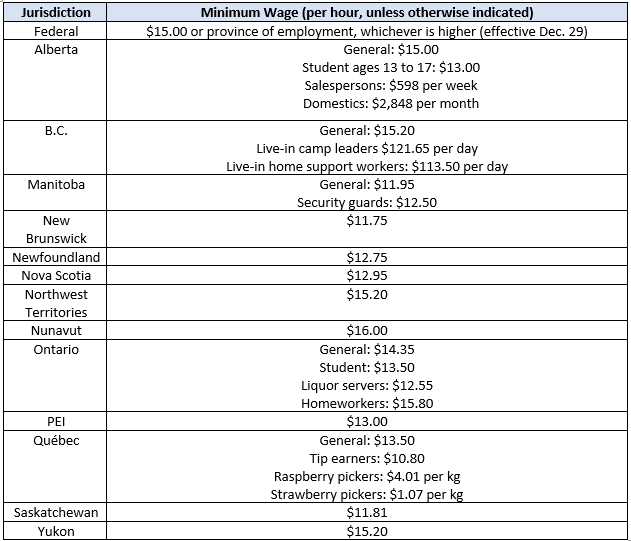
24 to 30: $14.25 per hour; and Example: Jenny, an Ontario mail clerk earning minimum wage has a bi-weekly pay period runs from Sunday, September 24 to Saturday, October 7. On Oct. 1, 2021, Ontario’s general minimum wage increased from $14.25 to $14.35 per hour. Jenny’s pay:
- 1 and thereafter: $14.35 per hour.
Pay Period Compliance Adjustments
The same principles apply in situations where compliance with the minimum wage is on a pay period basis, i.e., where the total earnings in the pay period, divided by the hours worked in the pay period, must be at least equal to the minimum wage. In these situations, minimum wage changes that take effect between the first and last days of the pay period, must be calculated separately:
- Earnings in the pay period before the minimum wage changed, divided by the corresponding hours, must be at least equal to the old minimum wage; AND
- Earnings in the pay period from the effective date of the minimum wage increase, divided by the corresponding hours, must be at least equal to the new minimum wage.
Scenario: Nigel sells electronics in a big box store subject to Newfoundland ESA law. He earns both an hourly wage and commissions on his sales On Oct. 1, 2021, Newfoundland raised its minimum wage from $12.50 to $12.75 per hour. In the bi-weekly pay period from September 24 to October 7, Nigel makes a total of $800 in hourly wages and commissions for 70 hours work.
Question: Has Nigel’s employer met the Newfoundland minimum wage requirements? There are 2 things we need to know to answer that question:
- His earnings and hours of work from Sept. 24 to 30; AND
- His earnings and hours of work from Oct. 1 to 7.
Let’s assume Nigel worked 35 hours in both periods but earned $350 in the former period and $450 in the latter period. Result:
- From Sept. 24 to 30, his wage rate was $10 per hour ($350/35), which is below the required $12.50.
- From Oct. 1 to 7, his wage rate was $12.86 per hour ($450/35), which is above the required $12.75.
Bottom Line
If you’re in one of the provinces that just raised its minimum wage—Saskatchewan, Manitoba, Ontario, Newfoundland—make sure you get your pay calculations right for the pay period in which the rate increase took effect.
Minimum Wage Rates Across Canada (as of October 1, 2021)