When you’re starting to drown between employee concerns, payroll duties and helping your CEO -- HR Insider is there to help get the logistical work out of the way.

Times are too frantic to allow for the usual summer lull. June 1, to September 30, 2026, was a very active period on the employment law compliance front. Here’s a briefing on the most important new laws and cases affecting HR directors that came down during the quarter.
Top 5 New HR Laws
There were significant regulatory changes affecting payroll operations during the third quarter, including minimum wage increases and revised Social Insurance Number (SIN) registration rules. Meanwhile, the escalating trade war with the U.S. is having major ramifications on many Canadian companies’ HR operations.
1. New U.S. Tariffs Create Compliance Challenges for Canadian HR Directors
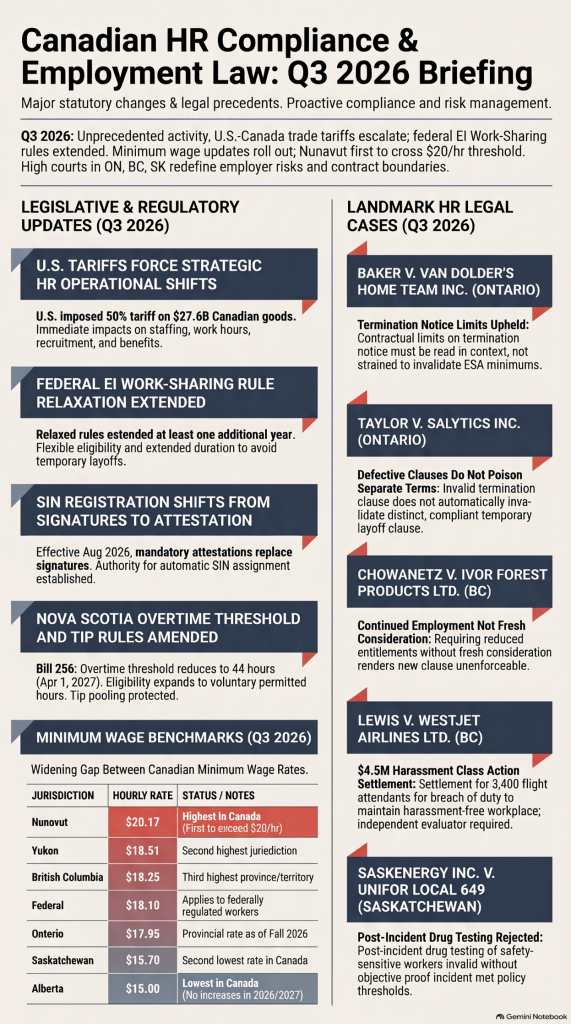
The trade war escalated in September when the U.S. imposed a 50% tariff on $27.6 billion of Canadian goods. Canada responded in kind with additional tariffs on U.S. products. And it’s Canadian HR directors who are caught in the crossfire. While U.S. trade isn’t an HR issue, it forces companies to make tough decisions that directly impact staffing, work hours, recruitment, compensation, benefits, and other vital HR operations.
What To Do: Get a full briefing on the workplace ramifications of the trade war and the 8 things Canadian HR directors can do to help their companies survive the impact of tariffs.
2. Federal Government Extends Temporary Relaxation of EI Work Sharing Rules
The federal Employment Insurance (EI) Work Sharing Program is designed to help companies experiencing significant decreases in normal work levels for reasons beyond their control avoid temporary layoffs. When Trump began imposing his tariffs in 2025, Service Canada temporarily relaxed program rules to make it easier for companies to take advantage of Work Sharing. The temporary changes, including expanded eligibility criteria and longer duration limits, were due to expire this fall, but the government extended them for at least one more year.
What To Do: If your company is struggling right now, don’t hit the temporary layoffs button until you give Work Sharing a look. Find out about the 10 things HR directors need to know about the program to help their organizations take advantage of it.
3. Minimum Wage Hikes Take Effect in 6 Jurisdictions
Manitoba, Nova Scotia, Prince Edward Island, Saskatchewan, Northwest Territories, and Nunavut all implemented minimum wage increases this fall. Nunavut became the first Canadian jurisdiction to cross the $20 minimum wage threshold when it raised its general minimum wage to $20.17 on October 1. At $18.51, Yukon is second on the list, followed by British Columbia ($18.25), the federal jurisdiction ($18.10), and Ontario ($17.95). On the other end of the spectrum, Alberta has the lowest minimum wage at $15.00 per hour; it’s also the only province that didn’t raise its minimum wage in 2026 and hasn’t scheduled an increase for 2027. Saskatchewan has the second lowest minimum wage at $15.70.
What To Do: Minimum wage increases create administrative challenges for HR and payroll. Find out how to avoid common payroll errors when adjusting to minimum wage increases.
4. Attestation Replaces Signatures for SIN Registration
One of the most significant new HR laws of the quarter happened very quietly in August when Employment and Social Development Canada (ESDC) revised federal regulations requiring attestation rather than a signature to register for a SIN. The new rules remove the right of SIN applicants to mark their applications if they’re unable to sign. They also make registration mandatory while requiring ESDC to assign a SIN to persons who are legally required to have one and don’t apply.
What To Do: Collecting SINs from new employees can be a tricky process fraught with hidden legal risks. Find out how to do it effectively.
5. Nova Scotia Revises Its Overtime & Tips Pooling Rules
On September 18, Nova Scotia Assembly passed legislation amending its Labour Standards Code (LSC) to reduce the overtime threshold from 48 to 44 hours per week while making extra hours that are voluntary and permitted eligible for overtime, as opposed to just overtime hours required by employers under current rules. Bill 256 also extends LSC pay frequency and pay protections to tips and gratuities and sets new rules for tip pooling and redistribution arrangements. All changes take effect on April 1, 2027.
What To Do: Find out about the 10 most common overtime mistakes Canadian companies make and about when tips and gratuities are subject to EI and CPP deductions.
Top 5 HR Cases
The HR case highlights of the third quarter were a pair of Ontario high court rulings favouring employers on an issue where employers hardly ever win, namely, the enforceability of clauses purporting to limit an employee’s rights to notice for without cause termination. There were also important cases involving workplace harassment and drug testing.
1. Ontario High Court Eases Enforceability of Termination Notice Limits
What Happened: A 71-year-old controller received the Ontario Employment Standards Act (ESA) minimum two weeks’ notice after being terminated without cause under a clause allowing for termination “at any time. . . for any reason, without just cause, upon providing you with only the minimum notice, or payment in lieu of notice. . . required by the ESA.” Going against normal tendencies, Ontario’s highest court, the Court of Appeal, unanimously ruled that the broadness of the language alone wasn’t enough to make it an unenforceable denial of an employee’s ESA termination notice rights [Baker v. Van Dolder’s Home Team Inc., 2026 ONCA 568 (CanLII), August 6, 2026].
Significance: Baker offers much needed clarification and relief for employers seeking to contractually limit termination notice to the ESA minimum. Historically, courts have seized upon the slightest ambiguity in the contract language to strike down the clause. Baker emphasizes that termination notice limits clauses must be read in context, with a view to the objective intentions of the parties, rather than through a literal, isolated reading that strains to find ambiguity where none exists.
What To Do: Find out more about employment contract termination notice limits and why they’re so hard to enforce.
2. One Bad Clause Doesn’t Poison All Other Termination Provisions, Says Ontario Top Court
What Happened: An employment contract included a clause allowing the company to temporarily lay an employee off if it faced financial difficulties. That’s what happened. The same contract also contained a termination notice limits clause of the contract that the court found in violation of the ESA. So, the employee claimed the temporary layoff clause was also invalid. But the Ontario high court disagreed, finding that the clauses were distinct provisions and that a defect in one didn’t necessarily poison the other. And unlike the termination notice limits clause, the temporary layoff clause did pass muster under the ESA and was thus enforceable [Taylor v. Salytics Inc., 2026 ONCA 621 (CanLII), September 3, 2026].
Significance: While termination notice limits will remain difficult to enforce, Taylor signals that courts—at least in Ontario—won’t lump them together with other parts of the contract addressing termination. Although binding only in Ontario, Taylor might influence courts in other jurisdictions.
What To Do: There are three things employers (especially but not just in Ontario) can do to take advantage of Taylor to shore up the enforceability of their own termination clauses:
- Recognize that temporarily laying off an employee will likely constitute constructive dismissal unless the contract specifically authorizes temporary layoff;
- Move temporary layoff clauses into a distinct section of the employment contract that’s separate from the clause purporting to limit ESA termination notice rather than lumping them all together under a broad “Termination of Employment” section; and
- Ensure that the distinct clause complies with all requirements governing temporary layoffs under the employment standards laws of your jurisdiction so that it’ll stand up to separate scrutiny.
3. Letting Current Employee Keep Job Isn’t Adequate Consideration for Contractual Giveback
What Happened: A Moulder Technician relocated from Calgary to Chilliwack to take a new job with a forestry products company in 2021. Three years and one wage increase later, he signed a new contract with the firm which, unlike the original, included a clause purporting to limit his notice for termination without cause to the minimum required by employment standards laws. When the company did fire him without cause, the Technician claimed the clause was unenforceable. The BC court agreed citing venerable legal principles holding that contractual agreements are enforceable only when the other party gets “consideration,” that is, something valuable in return. Employment wasn’t consideration for accepting the new termination notice limit, the court explained, because the Technician was already employed by the firm when he signed the new contract [Chowanetz v Ivor Forest Products Ltd., 2026 BCSC 1760 (CanLII), September 17, 2026].
Action Point: The takeaway from Chowanetz is that employment for an already employed person isn’t adequate consideration for pay, benefit, or other givebacks.
What To Do: Be sure to give employees fresh consideration, that is, something they didn’t already have, in exchange for agreeing to contractual concessions. Find out how to avoid contractual pitfalls when restructuring the terms of employees’ employment.
4. WestJet Pays $4.5 Million to Settle Flight Attendants’ Class Action
What Happened: A British Columbia court approved a $4.5 million settlement of a workplace harassment class action lawsuit against WestJet by approximately 3,400 current and former flight attendants. In addition to being a class action, the case is noteworthy because the claims were based not on Occupational Health or Safety or tort law but breach of the airline’s contractual duty to ensure flight attendants a harassment-free workplace. WestJet talked a good game about preventing harassment but didn’t make the necessary efforts to deliver on those promises, the plaintiffs claim. As part of the settlement, WestJet will have to hire an independent third party to evaluate workplace harassment prevalence, underreporting, and the effectiveness of its current reporting channels [Lewis v WestJet Airlines Ltd., 2026 BCSC 1547 (CanLII), August 10, 2026].
Significance: Don’t assume workers will tell you if they’re being harassed, bullied, or threatened at work. Many victims are too afraid to come forward, especially if they don’t think you’ll take their complaint seriously.
What To Do: Take active measures to find out if harassment is taking place such as by using pulse surveys to smoke out signs of a toxic workplace.
5. No Grounds for Post-Incident Drug Testing of Pipeline Workers, Says Saskatchewan High Court
What Happened: SaskEnergy ordered nine safety-sensitive union workers who were involved in two unrelated pipeline installation incidents to undergo drug and alcohol testing. The union claimed the company didn’t have just cause to perform post-incident testing. The Saskatchewan arbitrator agreed and SaskEnergy appealed to the province’s top court. The Court of Appeal sided with the union, finding that the arbitrator committed no obvious error in concluding that the incidents didn’t qualify as a “significant work-related incident” or “high potential incident” triggering the SaskEnergy’s right to test under the company’s post-incident testing policy [SaskEnergy Incorporated v Unifor Local 649, 2026 SKCA 94 (CanLII), August 26, 2026].
Significance: Workplace drug testing cases are often determined based not on what a testing policy says but how it’s implemented. This is especially true of post-incident testing where the issue is whether the injury or incident is enough to justify testing under the policy.
What To Do: Find out how to implement a legally sound and enforceable Drug & Alcohol Testing Policy at your workplace.