
 When you’re starting to drown between employee concerns, payroll duties and helping your CEO -- HR Insider is there to help get the logistical work out of the way.

Ontario is poised to become the first province to make workplace installation of life-saving automated external defibrillators (AEDs) an OHS requirement. Here’s a quick briefing of AEDs, how they’re regulated, and the requirements of the new Ontario law.
AEDs in the Workplace
An AED is an electronic device that can detect whether a person’s heart has stopped beating and deliver an electric shock to get it restarted. You don’t need first aid or any other special training to use it. The device lists clear and simple instructions that just about anybody can follow. By contrast, CPR does require training and isn’t generally effective against sudden cardiac arrest.
OHS laws require employers to have appropriate first aid personnel, equipment and supplies in the workplace. However, they don’t require AEDs. Still, many companies have implemented workplace AEDs programs and policies voluntarily because of their lifesaving potential and relatively low costs. Meanwhile, laws requiring AEDs are starting to pop up. The most notable example is in Manitoba where AEDs are mandatory in certain publicly accessible sites.
In May 2025, Ontario introduced landmark new legislation called Working for Workers Seven Act (Bill 30) that incorporates mandatory AEDs into OHS laws. Barring something unforeseeable, the Ontario Assembly will pass the bill before the year ends. Meanwhile, the Ministry of Labour, the agency that enforces the OHS laws in Ontario, published regulations to implement the new law. Here are the 8 key details you need to know to comply.
-
Worksites Where AEDs Are Required
The Regulations require constructors to install and maintain defibrillators at multi-employer construction project sites where 20 or more workers work and that are expected to last at least 3 months.
-
Who’s Responsible for Compliance
Primary responsibility for AEDs installation and maintenance falls on the “constructor,” that is, the contractor designated to be in charge of safety and compliance with OHS laws at a construction project site in which workers of more than one employer work.
-
Standards an AED Must Meet
The required equipment is a “defibrillator,” defined in Bill 30 as an automated external medical heart monitor and defibrillator that’s capable of:
- Recognizing the presence or absence of ventricular fibrillation or rapid ventricular tachycardia.
- Determining, without intervention by an operator, whether defibrillation should be performed.
- Automatically charging and requesting delivery of an electrical impulse to an individual’s heart as medically required.
- Satisfying any other prescribed criteria.
The new Regulations also specify that a defibrillator must be licensed as a medical device by Health Canada.
-
Equipment Required for AEDs
The Regulations list the items and quantities that must be stored with a defibrillator and maintained and replenished as necessary:
- One cardiopulmonary resuscitation mask.
- One pair of scissors.
- Two pairs of disposable medical grade gloves.
- One disposable razor.
- One garbage bag.
- Four absorbent towels.
-
Requirements for Storing AEDs
The defibrillator and required equipment listed above must be stored in “a suitable place” that:
- Allows for the defibrillator and required equipment to be kept together.
- Protects the defibrillator and the required items from dust, moisture, and other substances present at the project that could damage or affect its functionality or the functionality of the stored equipment.
- Clearly labelled with a sign that meets the requirements summarized in #X below.
- Is unobstructed and that facilitates easy access to the defibrillator and required equipment.
- If it’s outdoors, protects the defibrillator and required equipment from extreme temperatures, moisture, and direct sunlight.
-
Requirements for AED Signage
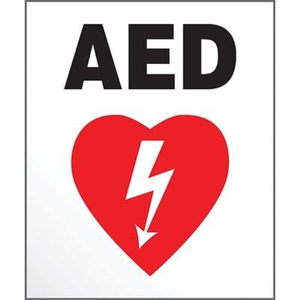
Signs must be posted near the defibrillator and at other locations throughout the project with information indicating the location of the defibrillator. A sign must include a graphic symbol that:
- Depicts a heart containing a lightning bolt.
- Contains the words “Automated External Defibrillator” or the acronym “AED” in English, or the words “Défibrillateur externe automatisé” or the acronym “DEA” in French.
-
Requirements for AED Inspection & Maintenance
Defibrillators must be maintained and tested in accordance with the manufacturer’s instructions. A competent worker must also inspect the defibrillator every quarter in accordance with the manufacturer’s instructions. The constructor must ensure that records of quarterly inspections are kept with the defibrillator that list:
- The date of each inspection.
- The name and signature of the competent worker who performed the inspection.
-
Requirements for Personnel
There must be a worker trained in cardiopulmonary resuscitation and defibrillator operation present at all times when work is in progress at a project.
Takeaway & Compliance Strategy
The Regulations indicate that the new AEDs requirements will take effect on January 1, 2026. But that’s subject to change. The Ontario Assembly is currently adjourned and won’t reconvene until October 25. That means that the legislation establishing the AEDs rules won’t pass until early November at the earliest. That would give constructors less than 2 months to comply.
Adding to the likelihood of a delay is that the legislation also calls for the Ontario WSIB to establish a scheme allowing constructors to be reimbursed for their costs in installing and maintaining defibrillators. This is likely to take time.
Best guess: The AEDs rules probably won’t officially take effect until the Spring, at the earliest.



